Afternoon
Raag Bhimpalasi
Bhimpalasi is a raag for the early afternoon, and what it carries is a quiet ache, closer to longing than to grief. Two of its seven notes are flattened, the third and the seventh, and nearly all of its feeling lives in those two. It climbs on five notes and comes back down through all seven.
The grammar, in plain words
The table above is the raag’s grammar, and it reads easily once the words are known. Hindustani music has seven notes, Sa Re Ga Ma Pa Dha Ni, and five of them come in two heights, a natural one and a flattened one, which is called komal. Bhimpalasi flattens two, Ga and Ni, the third and the seventh, and that is what puts it in the Kafi thaat, since a thaat is the family of raags that share one set of seven notes and Kafi is the family with exactly those two flats. The flattened third is the note that makes a tune sound minor to anyone raised on Western music, so a raag in this family starts out with a certain softness before anything else has happened.
Jati is the count of notes on the way up and the way down. Bhimpalasi is audav-sampurna, five up and all seven down. Climbing, it leaves out Re and Dha, and coming down it uses every note, so a phrase that rises through Sa Ga Ma Pa Ni and falls back through Ni Dha Pa Ma Ga Re Sa is already the raag in miniature. The vadi is the note the raag rests on and keeps coming back to, and the samvadi is its partner four or five notes away. Here the vadi is Ma, the fourth, with Sa as its partner, and that choice does more than anything else to give the raag its character. A raag that rests on the home note feels settled. A raag that rests on the fourth is always leaning, and Bhimpalasi leans on Ma so much that an older raag with the same notes, which rests on Pa instead, is told apart from it by that one thing.
The pakad is the short phrase that names a raag the way a face names a person. Bhimpalasi’s runs up from the Ni below Sa to Ma and settles there, turns through Ga and Ma, and comes down Ga Re Sa. Play that on any instrument and anyone who knows the music will say the name before you have played anything else.
Its hour
Every raag has an hour. The old day was divided into eight praharas of about three hours each, four for the daylight and four for the night, and every raag was given one. Bhimpalasi’s is the third prahara of the day, from roughly noon to three, which is why it is called an afternoon raag. The rule behind the assignment is a neat one. Raags whose resting note sits in the lower half of the octave, between Sa and Ma, are given the hours from noon to midnight, and Bhimpalasi rests on Ma. Whether the ear really hears the hour is a fair question. All I can say is that the one afternoon concert I’ve been to abroad, in a church off Trafalgar Square, opened with Bhimpalasi because it was the afternoon, and it sounded like the hour.
Where it turns up
Bhimpalasi is one of the most played raags there are, and part of the reason is that it works at every speed. It carries a slow aalap as well as a fast composition, it suits the voice and the instruments alike, and it has been sung in both of the traditions I practise. The Dagar brothers recorded it as dhrupad, and nearly every khayal singer of the last century has recorded it. The composition most students meet first is “Ja ja re apne mandirwa”, set to teentaal, the sixteen-beat cycle. Its composer is Sadarang, and that is a name worth knowing, because he and his nephew are the two composers who gave khayal the shape it has today, at the Mughal court about three hundred years ago. Of the recordings, a scholar of the raag ranked Kishori Amonkar’s above everything else on tape, with Kesarbai Kerkar’s just behind it.
It has also got into places classical music usually doesn’t reach. Its tune is under folk songs, stage songs, bhajans and film songs in several languages, and if you grew up in India you have almost certainly hummed it without knowing. “Naino Mein Badra Chhaye” from Mera Saaya is Bhimpalasi. So are “Khilte Hain Gul Yahan” from Sharmilee, “E Ri Main To Prem Diwani”, “Kuch Dil Ne Kaha” from Anupama, “Hum Katha Sunate”, the title song of the Luv Kush serial, and, at the other end of the register, “Tu Cheez Badi Hai Mast Mast” from Mohra. The South knows the same notes as Abheri, and “Nagumomu Ganaleni”, Tyagaraja’s, is the composition every Carnatic student meets in it.
What it is meant to do to you
The tradition doesn’t hand a raag a feeling on a label. It hands it a time of day, two flattened notes and a resting note, and the feeling comes out of those. The flattened third and seventh give it the softness of a minor key. The rest on Ma, a note that is not home, gives it a lean, the sense of reaching for something one step away and staying there. And the hour is the still part of the day, after the heat has settled and before the evening has begun. Put those together and you get what people have always heard in it, sweetness with an ache in it, longing rather than grief, the sound of an afternoon spent waiting for someone. An old writer on the raag called it very sweet and very dear, and said it has the power to take over the mind for days at a time.
What I hear in it, and what I try to let the recordings below hold, is the quiet ache named in the line under the title. Nearly all of it lives in the two komal notes and in how long you let Ma ring before you move.
Recordings
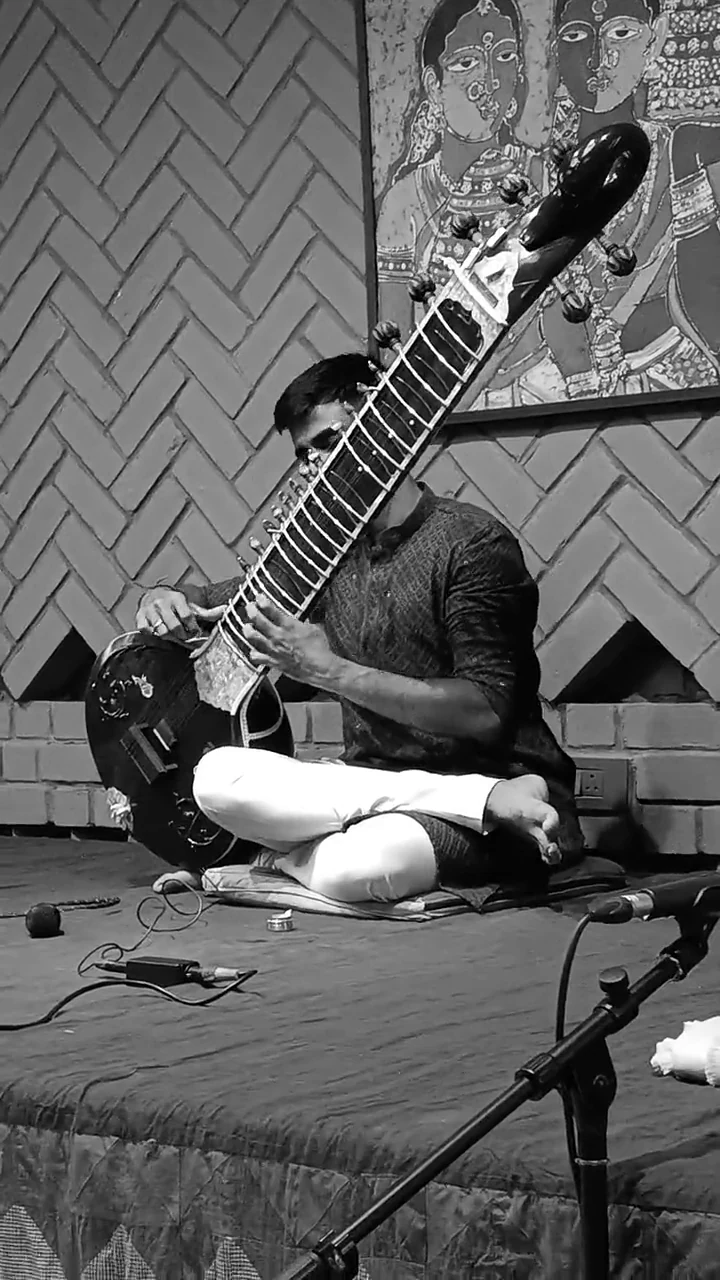
Gat in Chowtal
This is from the annual event my guruji, my teacher, conducts with all his students. I played Bhimpalasi on the surbahar, the bass sitar, in dhrupad, the older and the slower of the two styles I learn. My performance began with fifteen minutes of aalap, the slow opening before any beat comes in. The recording picks up at the gat that followed, a fixed composition set to chowtal, the twelve-beat cycle dhrupad uses.
Aalap and Jor
Fifteen minutes of aalap, the raag opened one note at a time with no pulse to lean on. Then jor, where the chikari strings start keeping time and the phrases tighten around them. Bhimpalasi's komal Ga and Ni carry most of its feeling, and the aalap is mostly about letting them settle. It's practice, recorded as it was.